
Do you understand that, after the year 2222, this thing became real?
Just look out the window. Just walk the streets, cross corners, watch faces and silences. If you’re not the next victim, you’ll notice: you are already inside a movie — not one to be released, but one that happens every day, in real time.
But there is another side. There is. It doesn’t scream, it doesn’t get a trailer, it doesn’t sell collectible figurines. It’s the side of people who, even living in the epicenter of noise, choose to build microscopic peace: someone who disables a patrol drone with an improvised magnet just so a couple can cross the avenue unscanned; a woman who grows gardens in ammunition crates and distributes food as if handing out a survival password; children who turn prosthetic scraps into toys and laugh with the seriousness of one who is repairing the world.
And yes, this opposes the impulse for war — not with flags, but with repeated gestures. Because violence demands spectacle, demands an audience, demands that you believe there is no alternative. Yet, in alleys and on balconies, under broken lights and screaming advertisements, there are still people practicing a kind of counter-spell: care, pact, community. Small. Insistent. And when you look closely, you realize: it’s not that there is no war. It’s that there are also those who, in the midst of it, are learning to craft the future with their own hands.
The city pulses like a hybrid organism, caught between concrete and code. Daily life has been invaded by invisible narratives, algorithms that shape decisions, flows that alter the course of reality without our noticing.
The city also pulses because it resembles a hybrid beast, yes — fiber-optic nerves, concrete bones, advertisement skin. Yet there are still spaces within this enormous body, another side you hardly see because it doesn’t make noise: people learning to breathe outside the imposed rhythm. While algorithms push choices as if they were destiny, there are those who plant noise on purpose — not empty noise, but human noise: meetings without records, routes without tracking, decisions made eye to eye rather than by recommendation.
Kitchens turning into assemblies, workshops turning into temples, music flowing through alleys like a password; people sabotaging their own predictability so they don’t become data. And that’s when the game changes. Because the code shapes, yes, but it does not close its hand around everything: there is always a crack where the city remembers it is also people, and people — when they want — rewrite the flow.
What you once called fiction — wizards, powers, energy manipulation — now infiltrates everyday life with the grimy elegance of a badly lit place — a decadent charm, beautiful by accident and ugly by vocation. Neon trembling in an oil puddle. Expensive suit smelling of old smoke. Sophisticated interface on top, makeshift and structural violence underneath. A world where everything seems “stylish” until you touch it and feel the rust.
It doesn’t appear as a spectacle. It appears as background noise: the neon trembling on the cracked glass of a bus stop, the AR overlay spitting out icons that don’t exist in any approved grid — a layer of Augmented Reality over what you see: floating labels, arrows, ads, “smart” signs, people’s names, routes, danger alerts, door statuses, prices for everything. It is not “on the screen” like a separate video; it is a digital painting glued to the world, delivering invisible layers: “monitored zone,” “camera at 12 m,” “open network,” “ghost shop,” “residual astral subscription.
And if someone hacks that layer… you can be guided down the wrong street, see a door that “looks” unlocked, or believe a warning that was planted.
It’s a world with subtitles — except the subtitles can lie. A rune that appears for a single frame on your visor and disappears when you try to zoom. The arcane did not return “against” technology. It latched onto it, like an intelligent parasite. It became the firmware of the impossible running beneath your city.
And the city… it smells. Of ozone, of old frying oil, of dusty acid rain, fresh graffiti glue, drone grease. Beneath the songs trying to sell serenity, there is a constant buzzing that is half network, half spirit. The hanging cables look like strangled vines. The cameras aren’t “cameras”; they are corporate eyes hungry for patterns. And sometimes, when the astral rises, they blink as if they’ve seen something they cannot report without driving the spreadsheet insane.
The mind, trained to separate “real” from “imaginary,” tries to raise internal firewalls. It classifies: sensory bug, implant glitch, astral deepfake, intoxication from cheap BTL — “Better-Than-Life” — total sensory experience chips/media that you don’t “watch”; you inhabit the sensation, a high-impact addiction because it delivers pleasure, adrenaline, escape, as if it were implanted memory.
Your reason works like outsourced security: it patrols, checks pockets, asks for ID from your own fear. But resistance now collects in the body. Microtremor in the hand holding the cup. Nausea when the “mana” line crosses an intersection. Lapses that are not forgetfulness — they are edits. As if someone wrote over your day with a pen, symbols that don’t exist in your alphabet.
The veil has already been torn apart. It was not opened ceremoniously. It was ripped by force, like a tent canvas in a gale, because two realities decided to occupy the same neighborhood without asking permission. And the worst part: the tear tries to normalize. It learns to look like “just another thing.” Magic does that. Technology does too. Both love to disguise themselves as everyday life so they don’t trigger an alarm.
You live inside the plot. Not as a spectator. As a component. As a circuit piece within an arcology — part architecture, part ecosystem, part social machine — a “vertical world” compressed into the same colossal block of interests: megacorps, cult-aesthetic gangs, fixers buying silence by the kilo, and that corner where a street shaman charges crypto to “clean” your astral while a decker — the digital intrusion operator of the underworld, the one who “enters” networks like breaking down doors, bypassing ICE/security, hijacking cameras, erasing trails, forging credentials, extracting data, and planting lies that look like truth — right next to them, invades your biometrics just to prove they can — the street version of a “systems engineer.”
And the plot is alive.
It responds, learns, smells you. What you call “story” isn’t in a book; it’s in the data traffic, in the camera map, in the mana line crossing the avenue, in the whisper that comes when you pass near a place where someone died with enough hatred to linger. You are not reading a narrative. You are being read by it — by sensors and by spirits, by algorithms and by entities that do not respect your notion of “possible.”
In the end, the feeling is simple and horrible: the world has grown larger than your explanation. And you still gotta go to work tomorrow.
To give you a better idea — after 2222 the world began to “disobey” in ways that even the most arrogant science could not frame. It wasn’t just strangeness. It was strangeness with a signature, as if someone were opening and closing a door without asking the universe’s permission. In a few weeks, the labs called it noise: electromagnetic interference, solar eruption, calibration error. Then they called it collective hysteria. Then they called it terrorism. There is always a comfortable name to avoid facing the new landscape.
But the facts did not behave like a delusion. A delusion does not leave a coherent spectral trace across sensors in different cities, at different latitudes, at times that do not align. Transmissions captured flashes that were not “normal” light: entire bands of the spectrum striking as if someone had drawn a luminous blade across the sky — ultraviolet and infrared dancing together, photons in patterns that seemed… almost like a language.
Traffic cameras choked and rebooted with missing frames, as if time itself had blinked. Surveillance neural networks recorded impossible checksums: faces with correct geometry, but with a “signature” that didn’t match, as if the identity were there and not there at the same time. And when you try to archive it, things get worse: logs cascading into corruption, atomic clocks drifting by microseconds — little, insignificant to a lifetime. Enough for a world to begin to creak.
And the figures… ah, the figures. They were not ghosts in the theatrical sense. They were volumes of luminosity crossing avenues as if the city were glass. Sometimes they looked like people. Sometimes like structures: arches, columns, fragments of landscapes that belonged nowhere on your map. An entire square would receive an “overlay” of another architecture for three seconds; buildings would display, in their reflections, a horizon that did not exist; the air would taste like metal and old rain. Then it vanished. It always vanished. Leaving only an electrical echo in the networks — and that silence you may have felt once, when you realize that reality is not guaranteed.
No one knew for sure whether it was a physical phenomenon, a synchronized hallucination, or a structural failure in the fabric of time. I will tell you the feeling that remained, and it is worse than any hypothesis: it felt as though the world had been remembered by something greater. And, for a moment too brief, our reality became just a layer — an interface — over another.
Governments called it atmospheric interference. Corporations called it informational hysteria. Ordinary people simply tried to understand why the air seemed to vibrate differently, as if the world were breathing on its own. And while satellites flooded with corrupted data, an avalanche of contradictory versions took over everything — headlines, forums, pirate transmissions. They called it “fake news” because it was easier than admitting that the distinction between reality and noise no longer existed.
Cities began to react like nervous organisms: lights flickered without cause, drones lost orientation, and in the peripheral districts people said certain voices whispered at frequencies the human ear was never meant to hear. Time stretched, electricity smelled like fear, and the general sensation was that something — a presence, an error, or a birth — was beginning to move within the very structure of the world.
It happened suddenly — like in those old horror tapes about transformations under the moon. In recovered records from your time, I saw creatures that existed within others, germinating inside flesh like seeds within acorns. For centuries, these presences breathed beneath the human mask, invisible, dormant within the texture of everyday life. Then something broke the disguise. Skins began to open in silence, shedding, peeling away like the husks of a snake after growth.
From the fissures emerged forms from ancient fantasy books, luminous and dissonant: tall elves, with slender muscles and distant gazes, breathing a grace that felt like forgotten science; dwarves with dense bones, unmoving as columns, shaped by the weight of earth and metal; vast orcs, pulsing with raw energy, flesh and fury balanced in the same rhythm; massive trolls, almost like living mountains, with slow, deep breathing.

The world, once unified and predictable, began to reveal the layers that sustained it — the biological and the mythical mixed within the same code. In the forests, many wild animals ceased to be mere fauna: they became horrors and wonders torn from ancient narratives, beasts covered in symbols, creatures shaped by something that resembled faith and calculation at the same time.
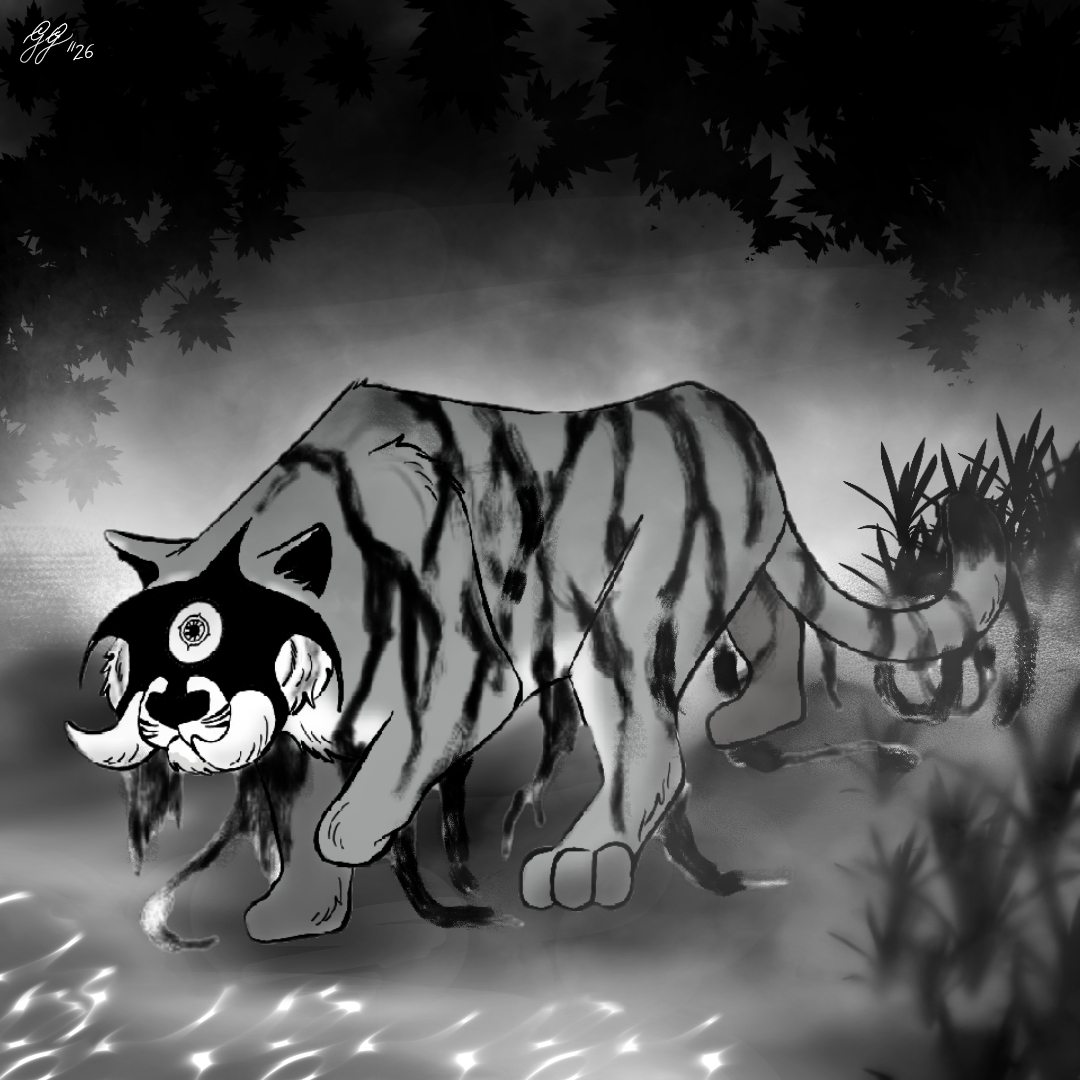
None of this truly began — it only began for your perception. Like when you discover a street that was always in your neighborhood, but your mind had no permission to see it. These parallel worlds were not born now; they have always existed alongside yours, like silent processes running in another layer of the system, like an entire city on the other side of the mirror… with traffic, hunger, laughter, worship, war.
The difference is that, one day, reality — that thin film some call “normal” — gave way by a millimeter. It was a tiny flaw in the first microsecond, almost polite: a checksum that didn’t match, a pattern repeating where it shouldn’t, a coincidence that became too persistent to remain coincidence. And when that surface loosened, nothing “appeared”: it leaked. The parallel spilled into the world like light invading through a crack in a door, and the once-familiar street became an unmarked border. Then, through that tiny fracture, the wind entered and tore the veil without mercy.
And think about the irony of the unsettled: in the 19th and 20th centuries, some had already sensed this. Not with sensors, not with satellites — but with those ancient antennas called body, mind, emotion, and spirit. They didn’t know how to say “layers of reality,” so they said vampires. They didn’t know how to say “interference between planes,” so they said medieval realms, wizards, creatures in the mist. Horror and fantasy were the social disguise of the unspeakable: a way to publish a warning without being devoured by ridicule, by science, or by the church. They were encoded accounts, maps drawn in fear. And now — now that the layers have truly touched — you understand what they sensed: it wasn’t idle imagination. It was the world trying to tell you, for a long time, that it always had more than one skin.